Cash Controls
Adapting operating routines after a funding round
Reconcile the completed round, stage new commitments and update approvals and reporting to the actual funding terms.

Archive
Cash Controls
Reconcile the completed round, stage new commitments and update approvals and reporting to the actual funding terms.
Cash Controls
Introduce a simple pre-commitment spending approval with a clear owner, total cost and written terms.
Operating Cadence
Settle who may make a disputed founder decision by checking existing authority, defining the question and agreeing a valid escalation route.
Early Hiring
Give a new employee a clear contact and a first piece of work with an expected output, decision boundary, reviewer and feedback point.
Cash Controls
Build a repeatable startup cash check using current balances, dated receipts and payments, variance review and clear follow-up owners.
Operating Cadence
A recurring meeting can outlive the problem it was created to solve.
Operating Cadence
Choose a weekly startup cadence for updates, decisions and escalation, then adjust it to the pace of the work.
Operating Cadence
Choose startup operating metrics by identifying the decision, the needed observation, its source and its blind spots.
Operating Cadence
Prioritise startup process guides by consequence, repetition and reliance on one person, then choose a checklist or procedure that can be maintained.
Delivery Ops
Preserve the promise, handoff and customer records, then build a timeline to find the failed step.
Early Hiring
Compare a targeted process change with hiring on the work each removes, time to benefit, supervision, cost and remaining capacity gap.
Founder Reporting
Identify recurring founder bottlenecks, define a usable mandate and check whether an operating role can move to another owner.
Delivery Ops
Turn an agreed service promise into checkable release conditions and a clear route for exceptions.
Operating Cadence
Map founding-team work, decision boundaries, overlaps and cover so recurring responsibilities have clear owners.
Early Hiring
Define an Australian startup role from real work, essential criteria, proposed hours, manager capacity and employment costs before advertising.
Operating Cadence
A weekly operating review should identify the few changes that need a decision.
Operating Cadence
Test the real cost of undoing a choice, then choose a bounded trial or a more careful approval path according to its consequences.
Operating Cadence
Triage urgent requests against standing startup commitments by checking deadlines, impact, authority and what must move.
Early Hiring
Organise employee onboarding with clear owners, Australian employment and safety essentials, supported first work and a first-month process review.
Operating Cadence
Turn accepted work and standing duties into a dated workload estimate by stage and skill, then compare it with usable team time.
Operating Cadence
A practical way for founders to frame decisions, assign authority, weigh consequences and evidence, then communicate and review the choice.
Early Hiring
Organise an early Australian employee hire from role definition and interviews through offer approval and the first-week handoff.
Delivery Ops
Check a proposed customer's scope and dates against existing delivery promises, bottlenecks and confirmed resources before accepting the work.
Operating Cadence
Find work that depends on one person's knowledge, access or authority, and check whether a proposed cover could act.
Operating Cadence
Put service checks at the useful step, set a clear release boundary and reserve extra review for consequential exceptions.
Cash Controls
Build a supplier inventory that identifies owners, commitments and the vendors whose failure would interrupt the startup.
Founder Reporting
An investor update and an internal task report answer different questions.
Operating Cadence
Document metric counting rules, check comparability and show definition changes without hiding breaks in the series.
Operating Cadence
Set a current home and owner for each operating procedure, manage approved changes and stop duplicate copies from confusing the team.
Delivery Ops
Map the route from an accepted customer order to delivery by identifying stages, handoffs, required inputs, decision points and completion.
Early Hiring
Assign interview stages, evidence and decision rights in a small Australian hiring team, with fair questions and a clear candidate handoff.
Operating Cadence
Plan a practical first response when a critical startup supplier fails, including backup, owner and customer communication.
Delivery Ops
Map launch work by phase, confirm scarce skills and cover, choose suitable temporary help, and set triggers for changing scope or dates.
Operating Cadence
Build an incident contact list with first responders, alternates, contact triggers and an accessible fallback copy.
Early Hiring
Map a new employee’s first tasks to equipment, accounts and permissions, assign owners and check what is ready before they begin.
Early Hiring
Build a first-week checklist for a new Australian employee with named owners, employment statements, safe induction, first work and follow-up.
Scaling Routines
Read delivery, rework and workload signals together, find the real constraint, and set a recovery test before taking on more demand.
Cash Controls
Make a startup runway forecast reviewable by recording the timing, basis, owner and uncertainty behind material cash assumptions.
Operating Cadence
Capture sales promises accurately, distinguish proposals from accepted terms and give delivery a clear record of scope, dates and conditions.
Delivery Ops
Keep customer promises visible with a compact record of terms, conditions, approval, owner, due date and follow-up.
Operating Cadence
Choose which founder decisions need a record, capture their reason and review trigger, and show clearly when a later decision replaces them.
Early Hiring
Identify the procedures a new employee needs for their first tasks, write usable instructions and use their first attempt to find missing steps.
Founder Reporting
Present startup forecasts with dated actuals, explicit assumptions, alternative cases and clear decision points.
Operating Cadence
Resolve conflicting instructions, retire stale copies from everyday use and preserve records that still need to be kept.
Cash Controls
Check who can administer critical accounts, whether each permission is still needed and how controlled recovery would work.
Operating Cadence
Compare new observations with the assumption behind a decision, assess uncertainty and decide whether to keep, change or replace the choice.
Early Hiring
Compare a new employee’s experience with the onboarding record, separate process gaps from training needs and assign fixes.
Operating Cadence
Use brief owner updates and existing evidence to review startup initiatives, resolve exceptions and remove redundant reporting.
Cash Controls
Review recurring software subscriptions for actual use, duplicate capability, renewal timing and safe exit.
Scaling Routines
Diagnose authority, supervision and skill gaps before adding a manager, then review whether the new reporting line improves decisions.
Scaling Routines
Find the constraint behind growing workload, then decide whether to simplify a process, delegate work, add capacity or change management.
Cash Controls
Distinguish pipeline, accepted work, recognised revenue and cash receipts in a startup management report.
Cash Controls
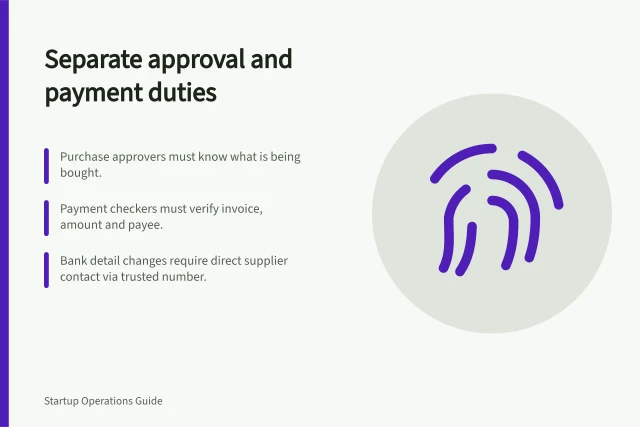
Split purchase approval, payment checks and release where possible, with a visible review when a small team combines roles.
Cash Controls
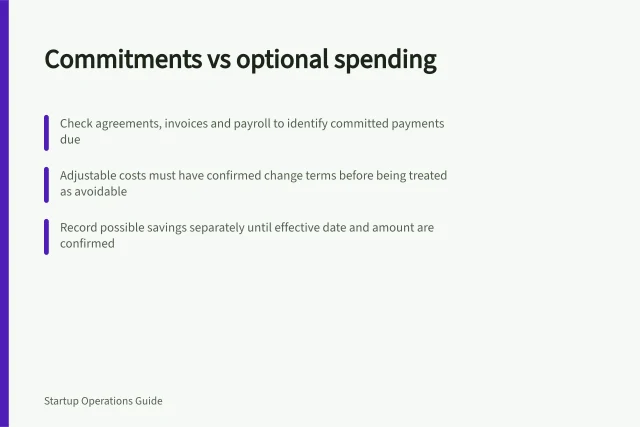
Classify startup spending by what is owed, what can change and when a decision could affect cash.
Operating Cadence
Trace a repeated task, agree its handoffs and exceptions, then identify the staffing need that remains.
Operating Cadence
Plan startup capacity from actual commitments, usable skills and bottlenecks, then decide when to simplify work, add help or change a promise.
Cash Controls
Connect a dated cash forecast, existing payment commitments and a cash check for proposed startup spending.
Delivery Ops
Build a practical route from accepted customer promises to delivery, with clear handoffs, capacity checks, exception decisions and customer updates.
Operating Cadence
Build a small, usable documentation system for startup procedures and customer commitments, with clear ownership and a way to retire outdated guidance.
Operating Cadence
Early-stage teams need a dependable way to notice problems and make decisions, but a growing calendar can become the work itself.
Operating Cadence
Build a small management information pack that supports startup decisions, separates actuals from forecasts and keeps measures comparable.
Operating Cadence
Build a simple startup operating system around responsibilities, decisions, escalation and a workable review rhythm.
Operating Cadence
Turn a startup’s direction into a manageable set of initiatives, clear outcomes and review decisions that keep the plan useful.
Cash Controls
Map critical dependencies, review account access, check payment steps and prepare incident contacts for a young company.
Delivery Ops
Set a service standard, check work before release, learn from corrections and improve customer handoffs without unnecessary approvals.
Operating Cadence
Keep startup suppliers visible, spending authorised, subscriptions reviewed and continuity options ready.
Delivery Ops
Define rework, record corrections and interpret affected-job rates without confusing defects with new customer requests.
Operating Cadence
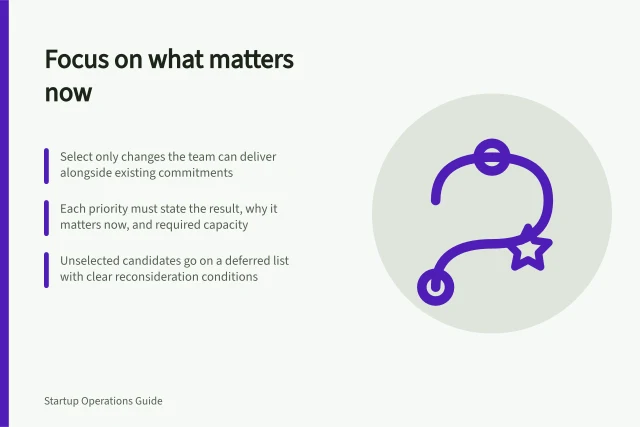
Compare candidate initiatives against strategic value, evidence, capacity and trade-offs, then choose what the team will do now.
Operating Cadence
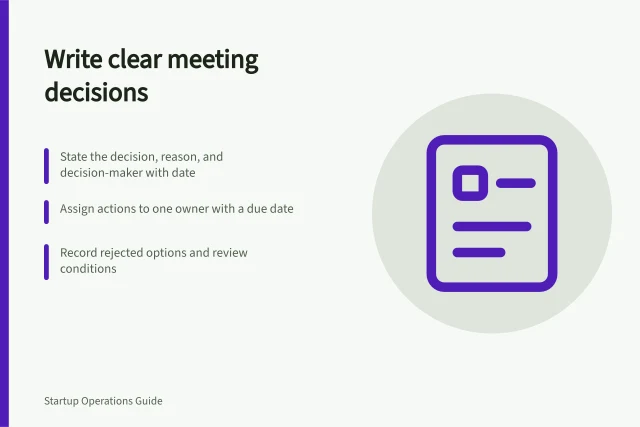
A meeting summary should let an absent teammate know what was decided and what happens next.
Operating Cadence
Write a compact initiative record that names its owner, intended outcome, evidence, dependencies and decision boundary.