Operating Cadence
Part of Founder decision-making
Distinguishing reversible from hard-to-reverse decisions
Test the real cost of undoing a choice, then choose a bounded trial or a more careful approval path according to its consequences.
To judge reversibility, describe what undoing the decision would require. A team may restore an internal process yet still leave a cost, obligation or effect on someone who relied on the change. Where reversal is practical, use a bounded trial; examine persistent consequences before committing.
Test the cost of undoing the choice
Ask:
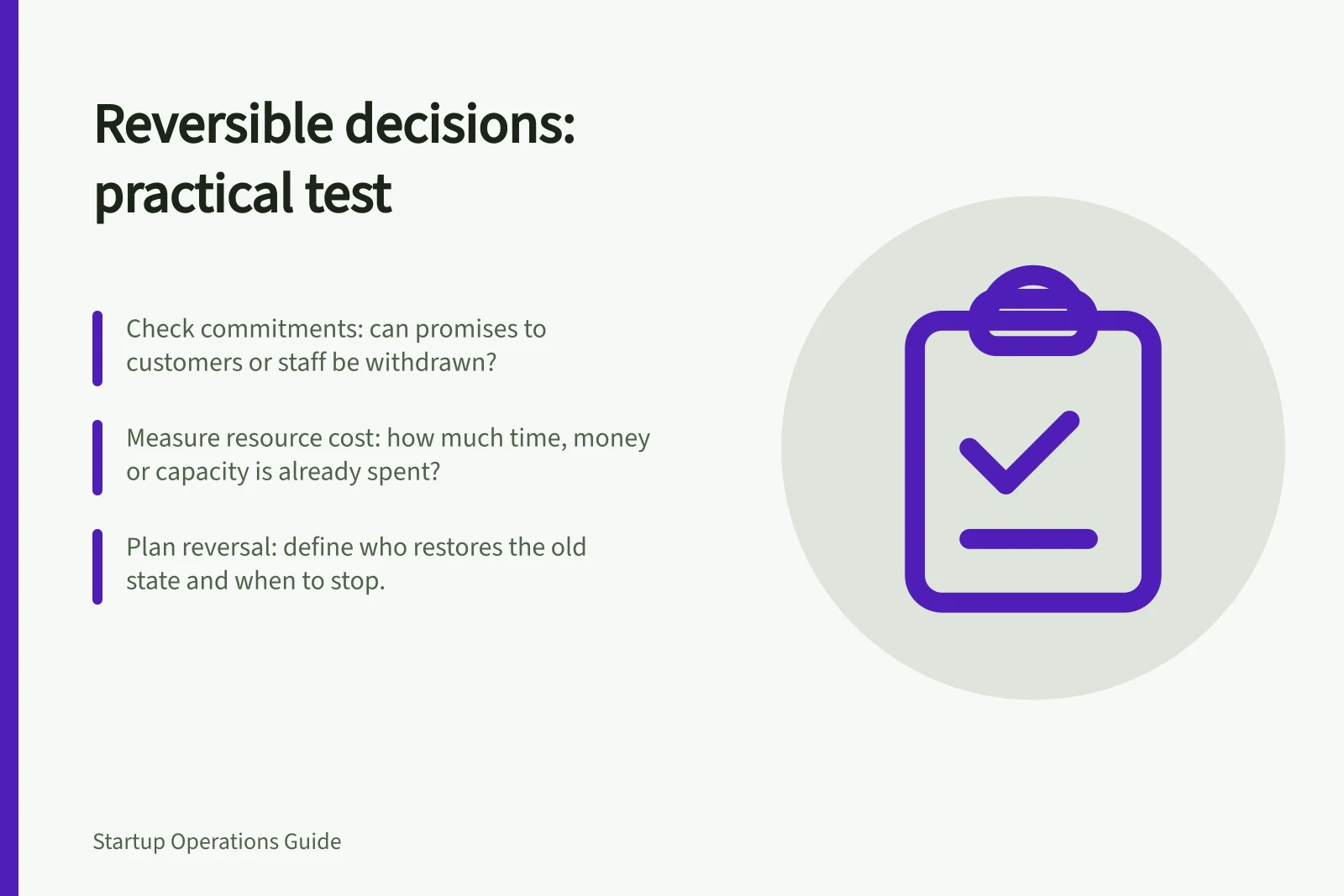
- Commitments:Has a customer, employee, supplier or investor been given something to rely on? Check actual terms before assuming it can be withdrawn.
- Resources:What time, money or scarce capacity would already be spent?
- Operations and data:Can the former process, information and access be restored?
- People:Who would have to change work or be told of a reversal?
- Timing:Is there a point after which reversing becomes much harder?
Describe the result, not a bare label. “We can restore the old internal form, but must retrain staff” says more than “reversible”.
Reversible vs Hard-to-Reverse Decisions: Key Factors
- Commitments
- Customer, employee, supplier or investor reliance exists
- Resources
- Time, money or scarce capacity already spent
- Operations and Data
- Former process, information or access cannot be restored
- People
- Staff or stakeholders must change work or be informed of reversal
- Timing
- Reversal becomes significantly harder after a certain point
Choose a proportionate path
| What the undo test shows | Possible path |
|---|---|
| Effects are contained and the previous state can be restored | Set a limit, owner and check point, then learn from use. |
| Some effects remain after reversal | Reduce exposure, test a smaller step and state when to stop. |
| A commitment or consequence would persist | Confirm authority, material facts and alternatives before acting. |
These are working descriptions, not fixed classes. A contained internal trial can become a harder-to-reverse choice if its result leads to an external promise.
A hypothetical startup might trial a different order for two internal review steps on a limited set of cases, provided staff know how to restore the old route. Signing a long-term agreement in reliance on that trial is a separate decision requiring its own review.
Bounded Trial vs Formal Approval Path
- Pros of Bounded Trial
- Low risk, quick feedback, internal learning without long-term commitment
- Cons of Bounded Trial
- May lead to unintended dependencies; requires clear exit conditions
- Pros of Formal Approval Path
- Higher scrutiny, better alignment with external commitments, documented rationale
- Cons of Formal Approval Path
- Slower, more resource-intensive, may delay innovation
Plan the reversal before acting
For a bounded change, write what will be observed, who can stop it, how the prior state would be restored and who must be informed. If the team cannot describe a credible reversal, investigate that gap before treating the choice as easy to undo.
For a lasting commitment, ask which facts must be checked first, whether it can be staged and what specialist or formal approval applies. Record why the team chose its level of scrutiny. If a later stage creates a new promise or cost, assess that stage as a new decision.
How to Plan Reversal Before Acting
- Define observable outcomesWhat will be measured during the trial?
- Assign decision authorityWho can stop the change if needed?
- Document restoration processHow will the prior state be restored?
- Identify affected partiesWho must be informed of a reversal?
- Assess long-term commitmentsIf new promises or costs arise, treat as a separate decision