Early Hiring
Part of Hiring operations for early teams
Preparing the first-week employee onboarding checklist
Build a first-week checklist for a new Australian employee with named owners, employment statements, safe induction, first work and follow-up.
Build the first-week checklist from the accepted offer and the employee’s initial duties. For each item, record an owner, a due point and how completion will be confirmed.
Start with employment administration and safe work. Then arrange first contact, access and a reviewed initial task. Move any item earlier if the role requires it before work begins.
Create a checklist for this starter
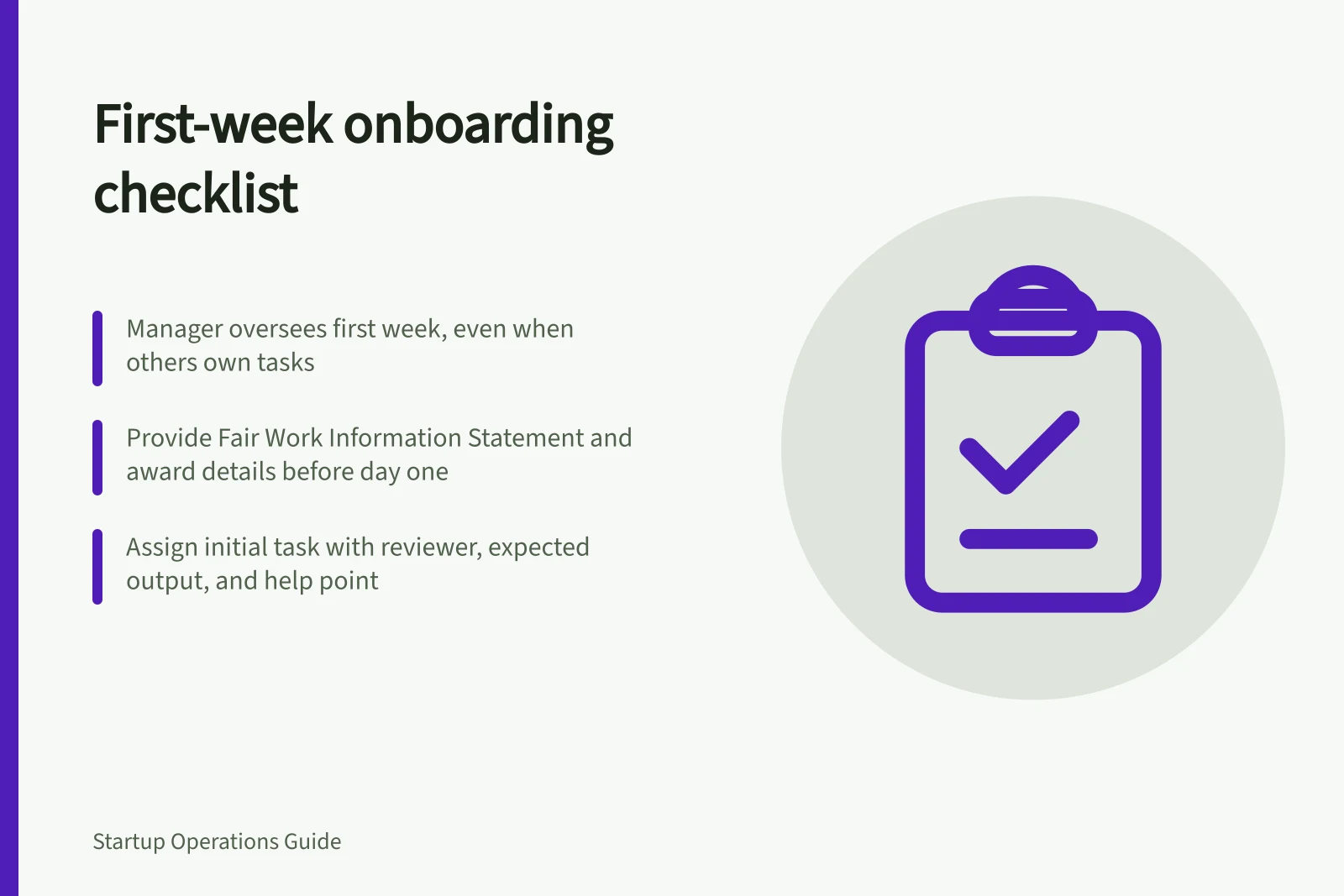
Put the employee’s role and start date at the top. The manager should oversee the first week, even when payroll, system administrators or supervisors own individual tasks.
Use four fields for each item: task, owner, due point and completion evidence or blocker. Keep tax, bank and other sensitive details in the appropriate restricted system rather than copying them into a shared tracker.
| When | Item to assign | Completion check |
|---|---|---|
| Before arrival | Confirm start time, place or remote joining details, and first contact. | The employee has the details and the contact expects them. |
| By its applicable due point | Provide the applicable employment information statement or statements. | Record which statement was given and when. |
| Before the first relevant task | Arrange role-specific equipment, access, safety instruction and supervision. | The responsible person confirms what works and what must wait. |
| First day | Explain relevant hazards, safe procedures, emergency arrangements and where to get help. | The supervisor checks the employee can begin the assigned work safely. |
| During the week | Assign an initial task and a reviewer. | The employee knows the expected output and review point. |
| End of week | Review blockers and outstanding administration. | Each open item has an owner and next date. |
An account or device request is not proof that it works. If access fails, assign the problem and choose suitable work that can proceed safely. Do not mark a current safety or access problem complete just to close the checklist.
First-Week Employee Onboarding Checklist (Australia)
- Before arrivalConfirm start time, place or remote joining details, and first contact
- By its applicable due pointProvide the applicable employment information statement (Fair Work, Casual, or Fixed-Term)
- Before the first relevant taskArrange role-specific equipment, access, safety instruction and supervision
- First dayExplain relevant hazards, safe procedures, emergency arrangements and where to get help
- During the weekAssign an initial task and a reviewer with clear expectations
- End of weekReview blockers and outstanding administration; assign owners and next dates
Check employment essentials at the right time
Before relying on employment guidance, confirm which requirements apply to the business and employee. During induction, business.gov.au recommends providing information about employment conditions, including a copy of the applicable award or agreement and the Fair Work Information Statement.
For a casual employee, check current Fair Work guidance on the Casual Employment Information Statement. Record any required action and timing.
For a fixed-term employee, check current Fair Work guidance on the Fixed Term Contract Information Statement. Record any required action and timing.
Assign someone to prepare payroll and tax arrangements, including tax file number information, pay as you go withholding and Single Touch Payroll where applicable. Check superannuation choice and payment steps for the employee.
Record any applicable superannuation choice task and its due date after checking current guidance for any deadline.
Confirm the employee knows their agreed hours, reporting line, how to record work and whom to ask about pay or a roster.
Check the applicable award, agreement or state-system requirements instead of treating a generic checklist as the answer to an individual entitlement question.
Employment Information Statements for Australian Employees
- Standard Employee
- Fair Work Information Statement (FWIS)
- Casual Employee
- Casual Employment Information Statement
- Fixed-Term Contract Employee
- Fixed Term Contract Information Statement
Close the first week with a clear next action
Choose initial work that can be attempted with the instruction and supervision the role needs. State its expected output, reviewer and point for asking for help. At the check-in, ask what the employee could do, what was unclear and what remains blocked. Give each unresolved item an owner and a next date.
The first-week checklist is complete when the employee knows their next work and contact, and the manager can see which support or administration tasks remain open.
Detailed equipment provisioning, procedure maintenance and later onboarding reviews can follow their own processes.
Key Steps in First-Week Onboarding for Australian Businesses
- Step 1Choose initial work suitable for the role’s supervision and training needs
- Step 2State expected output, reviewer, and point for asking for help
- Step 3Hold a check-in to discuss clarity, challenges, and blockers
- Step 4Assign owners and next dates for unresolved items
- Step 5Confirm employee knows their next task and contact; manager reviews open tasks