Early Hiring
Part of Employee onboarding operations
Recording internal procedures a new employee needs
Identify the procedures a new employee needs for their first tasks, write usable instructions and use their first attempt to find missing steps.
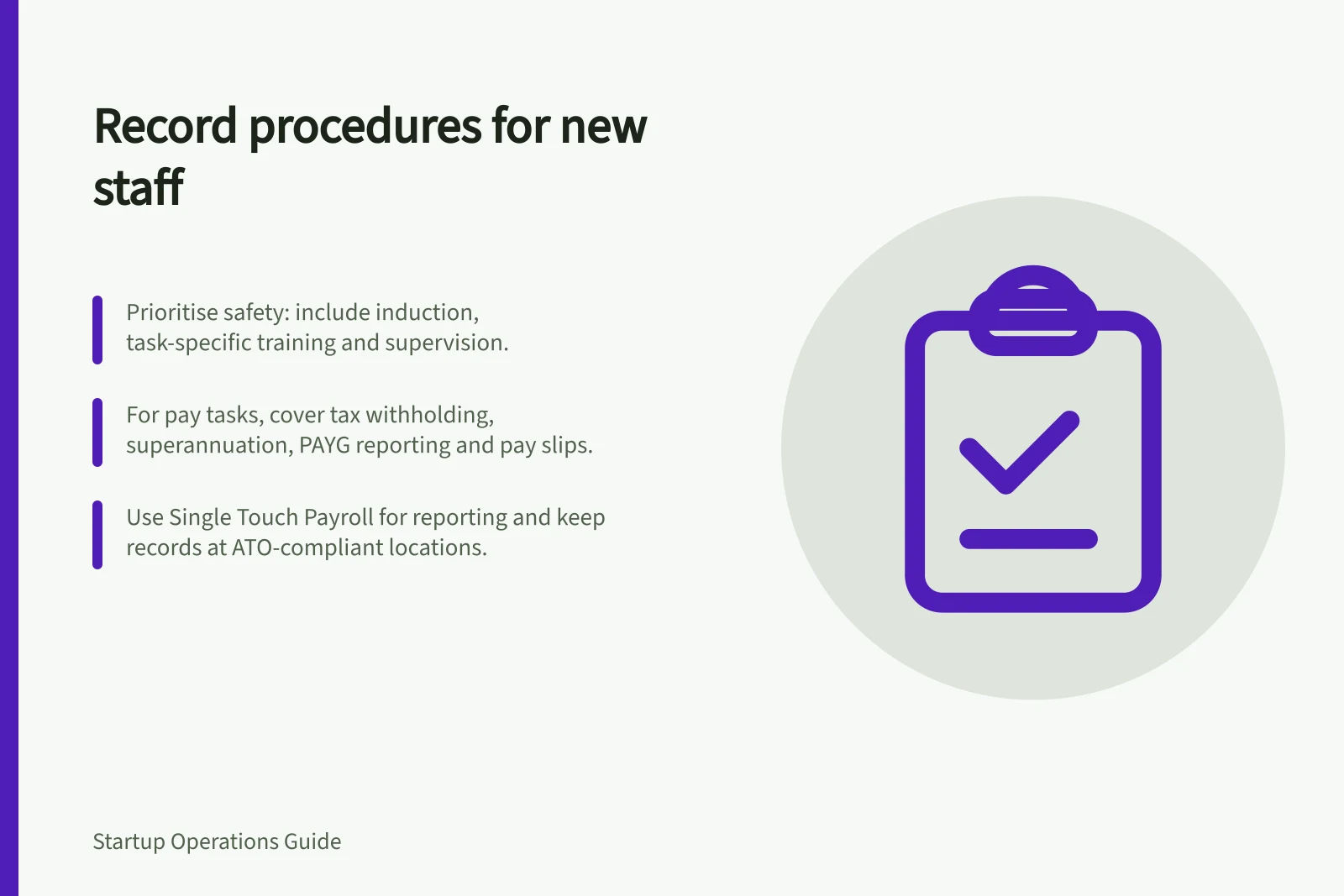
Choose procedures from this employee’s first tasks, then record usable instructions for each one. For every task, name the procedure, point to its normal current location and identify who can answer questions. Prioritise safety: workers must receive the training they need to stay safe, including induction, task-specific training, and ongoing training and supervision.
Build the list from the first tasks
For each planned first deliverable, ask what the employee must know before starting, where the instruction is recorded and which decisions need approval. Include routine steps, exceptions and escalation. Select procedures tied to this person’s assigned work; start with safety-critical tasks, tasks that are easy to do incorrectly, or knowledge held by one person.
Use the employee’s duties to choose relevant procedures. If they will handle pay-related work, the instruction may need to cover calculating pay accurately, withholding tax, paying on time and providing a pay slip, paying super, and knowing when pay rates change. If their role includes reporting or recordkeeping, consider procedures for reporting through Single Touch Payroll, paying PAYG withholding, keeping employment records, and keeping tax and super records.
Worked example — Handling requests: state where a request arrives; explain how to identify missing details; name who approves the response; specify where completion is recorded. Before the employee handles that task, make sure they can find those four points in the current procedure.
Keep policies and task procedures distinct. A policy sets a rule or expectation; a procedure explains how to carry out a task. Show the employee the policies and procedures relevant to their role, and record where each current document normally lives.
Provide health, safety and emergency information relevant to the employee’s work. Include the induction and workplace health and safety training for new workers, training for specific tasks, and ongoing training and supervision that the worker needs.
Check whether the first tasks call for forklift driver training, responsible service of alcohol (RSA) training or food safety training. These are examples of industry-specific training; needs depend on the industry and the employee’s experience, and some training is legally required. Safe Work Australia provides further health and safety training information.
Plan the induction so important information is not missed, and give the employee a schedule for the first week. Put relevant procedure locations and training on that schedule so the manager can see when the employee will review each task.
Introduce the new employee to their manager or supervisor, the workplace health and safety representative, fire wardens and first aiders. Make clear which contact can help with questions about each task.
Keep induction paperwork separate from task procedures. Provide the tax and super forms, information about employment conditions such as a copy of the award or agreement, and the Fair Work Information Statement as relevant.
Write each procedure so it can be used
Set out the answers before drafting. A task instruction should answer:
- When to use it:What starts the task, and which cases are outside its scope?
- What is needed:Which inputs, tools and permissions must be available?
- What to do:What are the main steps and checks before completion?
- When to stop:Which exception, safety concern or missing approval requires help?
- What to record:Where does the result go, and who receives the handoff?
- Who owns it:Who answers questions and approves changes to the instruction?
Apply those answers to the employee’s actual duties. For example, a procedure for pay-related work should cover only the pay, tax, super, reporting or recordkeeping actions assigned to that employee; do not assume every new employee performs them.
Use examples only when they can be shared appropriately. Remove customer or employee details the new starter does not need. Check that any screenshot reflects the current system and exposes no restricted information. Give the document a clear title and record its normal location.
Use the first attempt to find gaps
Ask the employee to use the procedure with their designated contact available. Note any missing step, unfamiliar term, inaccessible screen or conflicting instruction where they pause. Check whether the problem lies in the document, access or task assignment before changing the text.
Have the procedure owner correct the normal operating instruction and tell affected staff what changed. Make the correction where the current procedure normally lives, rather than relying on a separate onboarding copy. Keep the set small enough for the employee to use and the team to maintain.