Early Hiring
Employee onboarding operations
Organise employee onboarding with clear owners, Australian employment and safety essentials, supported first work and a first-month process review.
Employee onboarding is a series of handoffs: prepare the role and workplace, help the employee get started, support their first work, then fix process gaps. A small team can manage them in one tracker showing each task's owner, due date and status.
Set up the handoffs
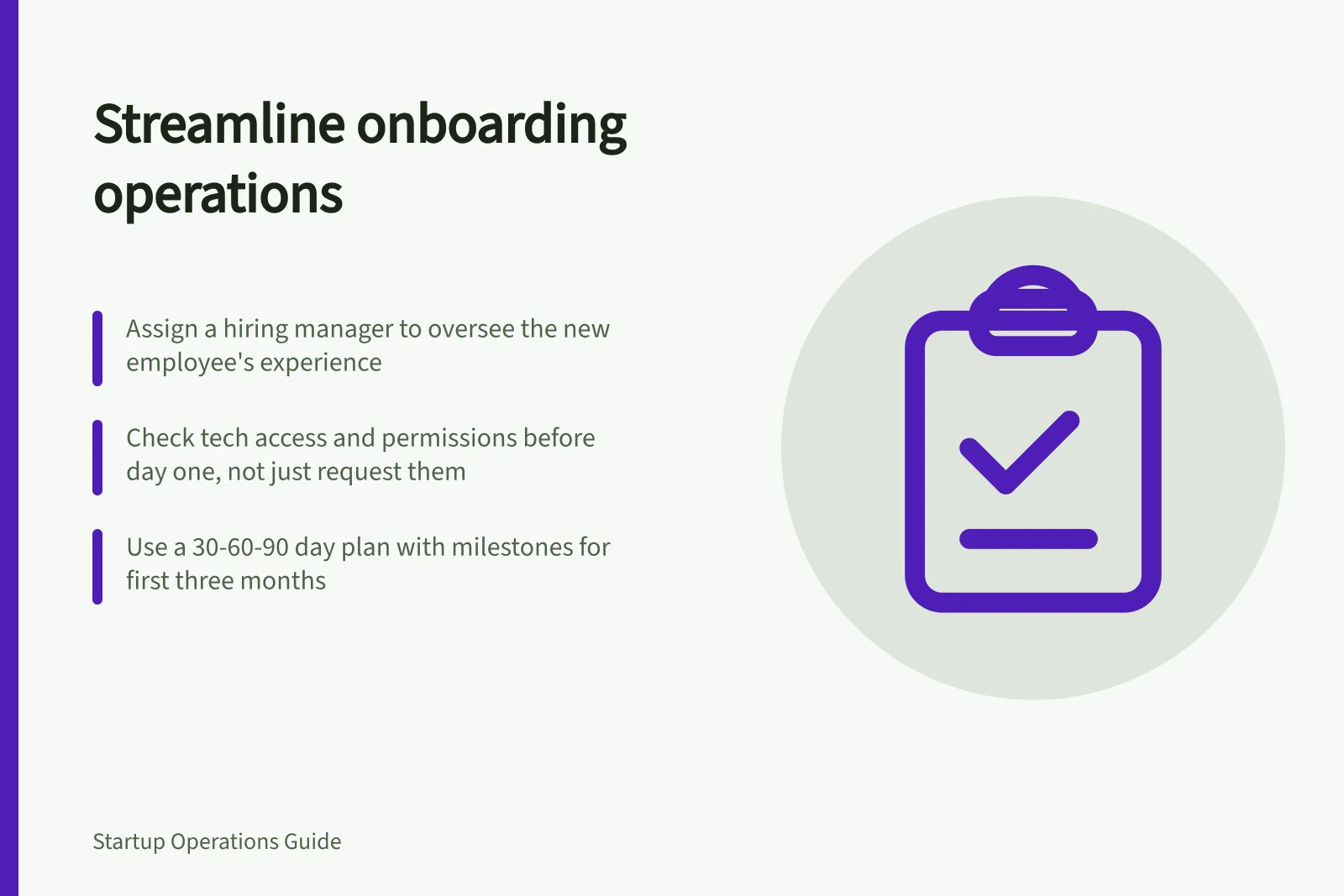
Give the hiring manager overall responsibility for the new employee's experience. Others may prepare payroll, equipment, accounts or training, but the manager must know whether those tasks are complete.
Name someone the employee can contact with everyday questions. In a small business, that may also be the manager.
For each task, record the employee and role, the task, its owner, its due date, and its status or blocker. Keep sensitive employment and identity information in the appropriate restricted system rather than copying it into a general task board.
| Stage | Decision to make | What to check |
|---|---|---|
| Before the start | What must be ready for this role? | Equipment, workspace, essential accounts and first-day details have owners. |
| First day | What must the employee know before working? | They know their contact, relevant safety information and where to get help. |
| First week | What can they do with guidance? | An initial task and its review point are agreed. |
| First month | What is still getting in the way? | Gaps are recorded, assigned and followed up. |
These are useful checkpoints, not a required timetable for every task. A shift worker, remote employee and specialist hire may need different equipment, training and introductions.
Prepare the person before day one
Send a pre-arrival information package covering the company, its culture and the role. Before the start, check that technology and system access are in place and working, not merely requested. Consider assigning a mentor or transition coach.
Pre-Departure Onboarding Checklist (Before Day One)
- Send pre-arrival information packageCompany culture, role overview, first-day logistics
- Confirm technology and system accessEmail, HRIS, payroll, cloud tools working and tested
- Assign a mentor or transition coachFor support during early weeks
Cover employment and safety essentials
Check the agreed employment terms and the business's payroll, tax and superannuation arrangements. During induction, provide tax and super forms, information about employment conditions (such as a copy of the relevant award or agreement and the Fair Work Information Statement), and work health and safety information.
Plan induction around the work the person will do. Explain relevant hazards, safe work procedures, emergency arrangements and supervision. Training needs vary by role and industry.
Record what has been covered and what remains outstanding. Ensure the employee has the instruction and supervision needed to work safely.
An induction can be a formal program or a checklist that you and the employee both follow. Use it to help them get to know the business, their role and other staff, and to hand over tax and super forms and a copy of the relevant award or agreement.
Business Queensland publishes a first-day induction list you can adapt.
Match induction training to the role
Training teaches the specific skills a job needs; professional development builds broader skills for future roles. Some industries require particular training, such as forklift driving, responsible service of alcohol or food safety.
Employers must give workers the training they need to stay safe and healthy, including induction and work health and safety training for new workers, task-specific training and ongoing supervision.
Make the first day usable
Send the employee their arrival time, location or remote joining details, and the name of the person meeting them. Prepare a place to work and a way to reach the team. Introduce close colleagues and explain how the role fits into current work.
Check essential access with the employee during induction. An account marked 'created' may still lack the right permission or a working sign-in method. Grant access for the role rather than administrator rights by default.
Use individual accounts and multi-factor authentication where available. If access fails, give the problem an owner and arrange other suitable induction work; do not share another employee's login as a shortcut.
Keep communication lines open after the first day: email to check in, include the employee in company-wide memos and emails, and invite them to meetings and social gatherings.
A standardised checklist used for every hire makes the first day easier to track and helps the employee feel supported.
Give the employee a first piece of work
Choose a genuine initial task with a clear reviewer. Describe the expected output, where to find the starting information, what the employee may decide and when to ask for help. Arrange a check-in after their first attempt and give specific feedback.
If missing access or an undocumented step delayed the task, fix that handoff as well as supporting the employee. Keep expectations clear as the work develops.
Set milestones for the first three months
A 30-60-90 day plan gives the first three months specific objectives and milestones. Hold regular check-ins to monitor progress, address emerging issues and look for early wins the employee can achieve. Make their contribution visible to the team.
Improve the next onboarding cycle
Compare the planned steps with the employee's experience and the manager's records. Look for late equipment, unclear ownership, missing procedures, training scheduled after it was needed or work assigned without a review point. Separate a process gap from a skill that needs coaching.
Assign each process fix an owner and a date. Address any current safety, access or training problem for the employee now, then check the revised step before the next hire.
In this guide
- Preparing equipment and access before a new hire startsMap a new employee’s first tasks to equipment, accounts and permissions, assign owners and check what is ready before they begin.
- Assigning an onboarding contact and first deliverablesGive a new employee a clear contact and a first piece of work with an expected output, decision boundary, reviewer and feedback point.
- Recording internal procedures a new employee needsIdentify the procedures a new employee needs for their first tasks, write usable instructions and use their first attempt to find missing steps.
- Reviewing onboarding gaps after the first monthCompare a new employee’s experience with the onboarding record, separate process gaps from training needs and assign fixes.