Cash Controls
Part of Startup cash and spending operations
Recording assumptions in a runway forecast
Make a startup runway forecast reviewable by recording the timing, basis, owner and uncertainty behind material cash assumptions.
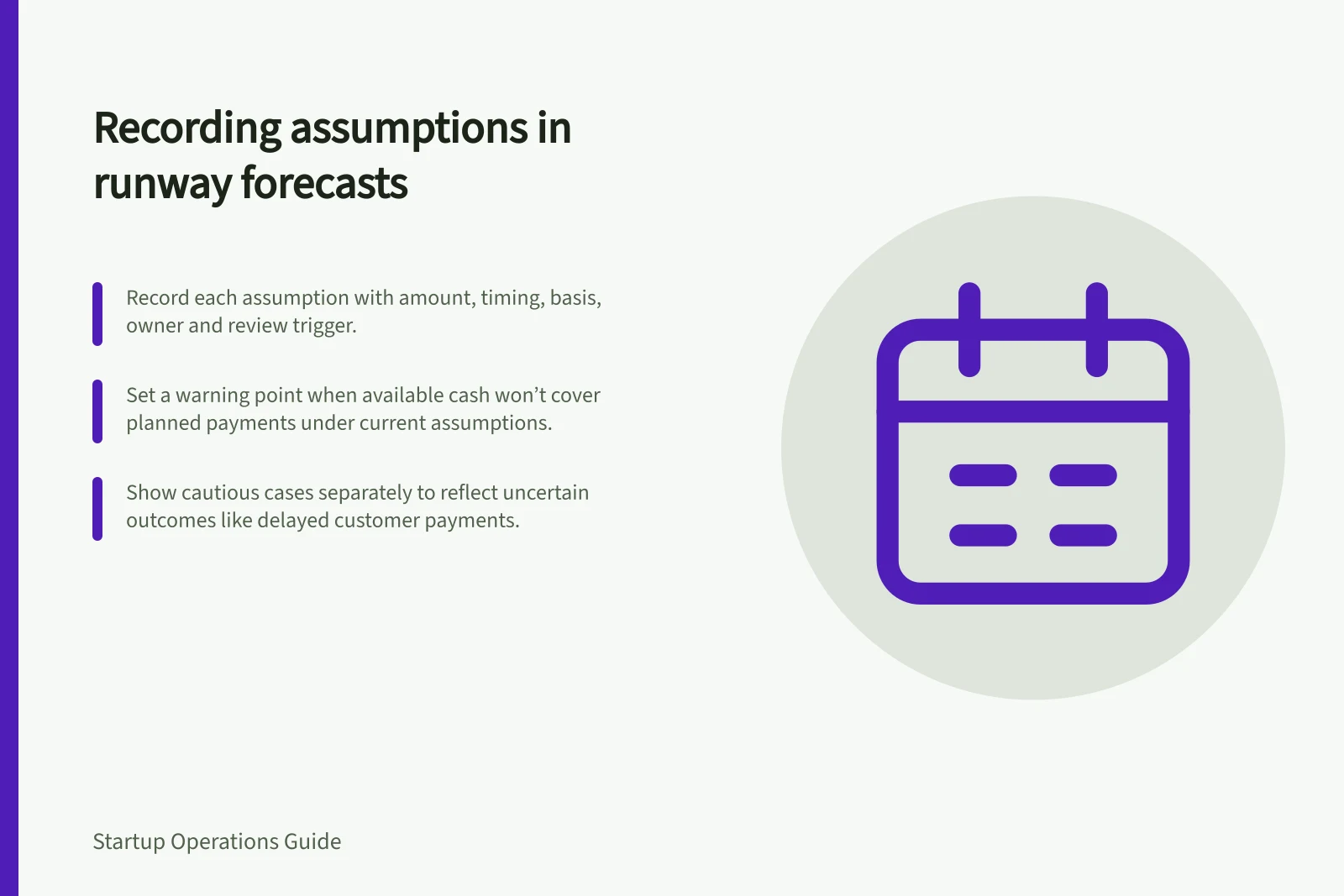
Record each material assumption beside the forecast: its amount, expected timing, basis, owner and review trigger. Show uncertain outcomes separately instead of presenting one end date as certain.
Define the warning point
Start with dated available cash and expected receipts and payments. For each forecast period, add incoming cash to the opening balance, subtract outgoing cash and carry the closing balance forward.
The warning point is the first forecast payment date, or the earliest shorter period the model can show, when available cash would not cover planned payments under the stated assumptions. It is a forecast signal, not a guaranteed date when the business will run out of money.
State which accounts and restrictions are included, the forecast horizon and how GST is handled. Include applicable GST settlements and other relevant payments without omitting or double counting them. A profit figure, sales target or issued invoice cannot stand in for cash expected to reach the bank.
Record the assumptions that could change the answer
Keep a short register for material inputs:
Field / What to record
- Event
- The receipt, payment or condition affecting cash.
- Amount and timing
- The expected cash effect and date or period.
- Basis
- An agreement, invoice, recent pattern, quote or labelled estimate.
- Uncertainty
- What remains unconfirmed and how a different outcome would matter.
- Owner and trigger
- Who will check it, and when or after which event.
For example, "Customer payment expected in November under agreed terms; owner to check after the due date" distinguishes the contractual date from actual payment behaviour. An estimate should remain labelled as an estimate even when entered into a spreadsheet.
Compare a working view with a cautious case
Use the best-supported expected timing for each receipt and payment in the working view. A signed agreement may establish an amount due without guaranteeing when cash will arrive. Where that timing is material, show a cautious case with a later receipt or higher payment.
Keep an uncontracted sale, prospective funding or proposed cost reduction as a separate possibility until its amount and timing have enough support for the decision at hand. If a decision depends on it, make that dependency explicit.
Suppose a large customer receipt is entered in the invoice month. Record the terms, collection owner and check date, then move the receipt later in a cautious case. If that case shows a payment gap, the team can consider action before the gap arrives. The example does not predict that the customer will pay late.
Update the reason and the result
Replace elapsed estimates with actual cash movements. For a material difference, record whether timing, amount or a missing item changed; update the assumption and recalculate later periods. Preserve a dated prior view so readers can tell whether the outlook improved because cash arrived or because an assumption became more optimistic.
A useful runway view shows the next payment risk, the assumptions driving it and who will check or act on them. When an updated forecast moves the warning point earlier or shows a payment gap, have the cash forecast owner review the affected assumptions before the next payment date.