Operating Cadence
Part of Startup metrics and management information
Choosing operating metrics tied to decisions
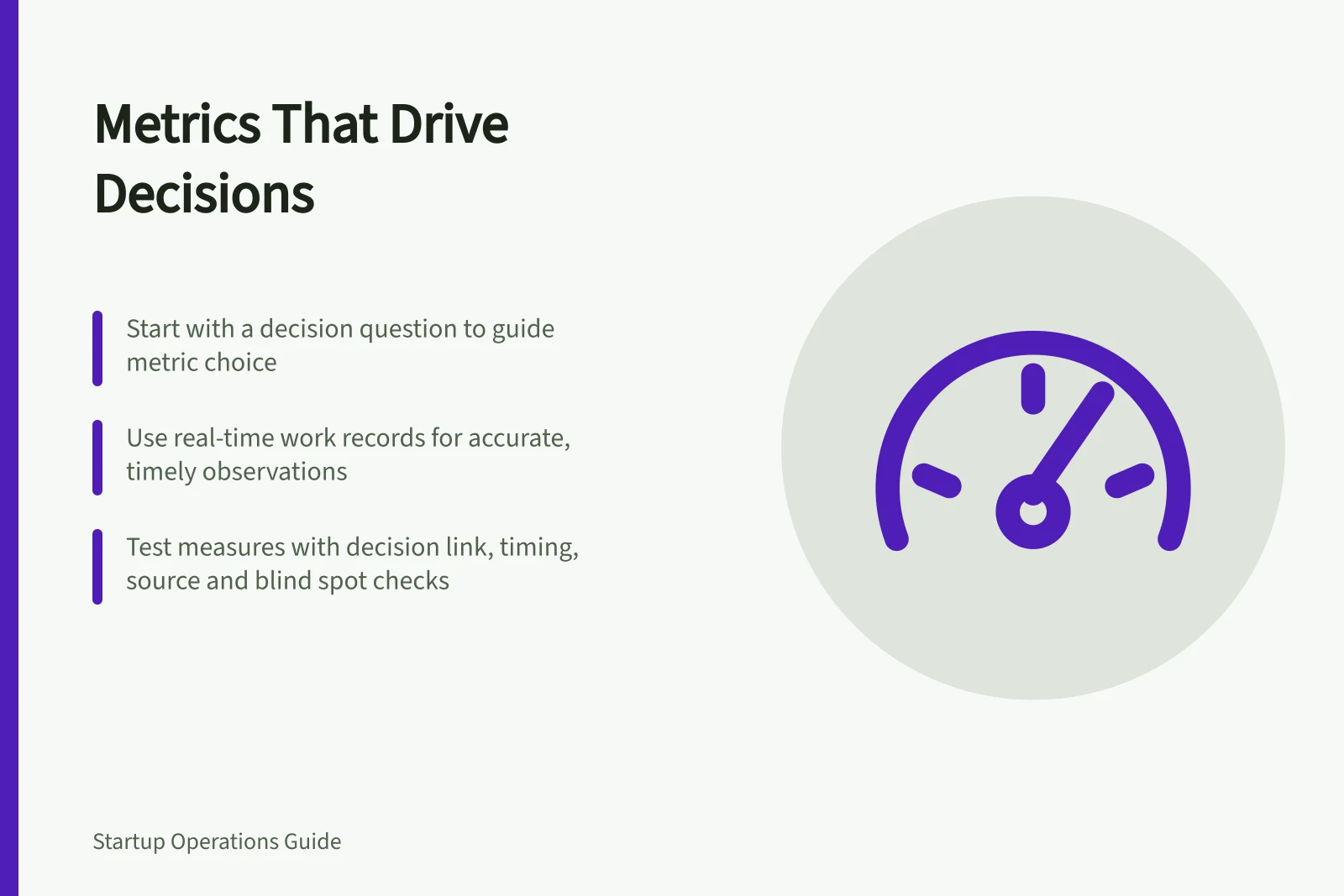
Choose startup operating metrics by identifying the decision, the needed observation, its source and its blind spots.
Begin with a decision the team expects to make, then choose the operating metric. Write that decision as a question, identify the change that would affect it, and choose an observation that could reveal that change. If the result would not alter any action, the measure may not belong in the regular review.
Start with the decision
Suppose a startup must decide whether to change how incoming customer requests are triaged. The total number of requests received shows volume, but not which requests waited too long for a first response. The team might examine unresolved requests at a stated cut-off, their age and the categories needing attention. These are possible observations, not a standard metric set.
Before collecting data, name who will use the answer, what they can change and when they need to decide. A figure that arrives after the decision point may be accurate but too late to help.
Choose an observation close to the work
Prefer a record created as the work happens. For a response-time question, that may be a request record with its received and first-response times. For a handoff question, it may be the point at which the receiving team accepted or returned a case. If the detail is absent, decide whether adding a field to the working record is worth the effort.
Test a proposed measure with these questions:
| Test | What to establish |
|---|---|
| Decision link | What choice could change because of this result? |
| Population | Which jobs, customers or events are counted? |
| Timing | When is the event recorded, and when is the result needed? |
| Source | Can a reader trace the figure to its working record? |
| Blind spot | What relevant work or outcome does the figure miss? |
A count may be enough to locate a queue. A rate may help compare periods with different volumes if its numerator and denominator cover the same eligible group and period. When only a few exceptions need a decision, a case list may be more useful than either. Show the underlying count beside a percentage so readers can judge its scale.
Observation Types: Count vs Rate vs Case List
- CountNumber of unresolved requests at cut-off time – useful for identifying queues.
- Case ListList of high-priority or overdue requests – best when only a few exceptions need attention.
Test a Proposed Metric Before Use
- Decision linkWill this result prompt a change in action?
- PopulationWhich customers, jobs or events are included?
- TimingWhen is the event recorded? Is the result needed before the decision point?
- SourceCan the figure be traced back to a working record?
- Blind spotWhat relevant work or outcome does this metric miss?
Use the result with judgement
Agree what movement would prompt investigation. A change is a signal to ask what happened, not proof that an initiative caused it. Check for altered workload, late entries, unusual cases or a changed counting rule before changing the plan.
If late first responses increase, inspect suitable requests to see whether the delay arose at intake, assignment or the response step. The measure points to a question; the cases help guide the response. Record the decision and whether the measure helped. Revise or retire it if it repeatedly fails to inform an action.
Key Principles for Effective Operating Metrics
- Actionable Insight
- A metric must lead to a decision, not just inform.
- Timely Data
- Result must arrive before the decision deadline.
- Traceable Source
- Figure must link directly to a working record (e.g., request log).
- Contextual Value
- Show count alongside percentage to judge scale.