Cash Controls
Part of Startup cash and spending operations
Separating committed expenses from optional spending
Classify startup spending by what is owed, what can change and when a decision could affect cash.
Classify spending by what the business can still change and when. A payment due next month may already be committed, while a budgeted activity may still be a choice. The result is a list of actions that could change cash before a tight payment period.
Check the decision point
Start with agreements, orders, payroll records, invoices and proposed purchases. For each item, ask whether the business has undertaken to pay, what amount is expected, when payment falls due, and whether any term, notice or other party’s agreement limits a change. An expense label such as “software” or “marketing” cannot answer those questions.
| Position now | Cash treatment |
|---|---|
| Due or otherwise committed | Include the expected payment; investigate any disputed amount or term. |
| Internally approved but not yet ordered or signed | Check whether approval or another action created a commitment before treating it as avoidable. |
| Adjustable under an existing arrangement | Show the current payment until the effective change is confirmed. |
| Proposed and unapproved | Assess its cash effect before a commitment is made. |
These labels are working tools, not legal findings about a contract. If the terms are unclear, ask the person responsible for the agreement and obtain advice where needed. A payment does not become optional because the team wishes it were.
Find when a change can take effect
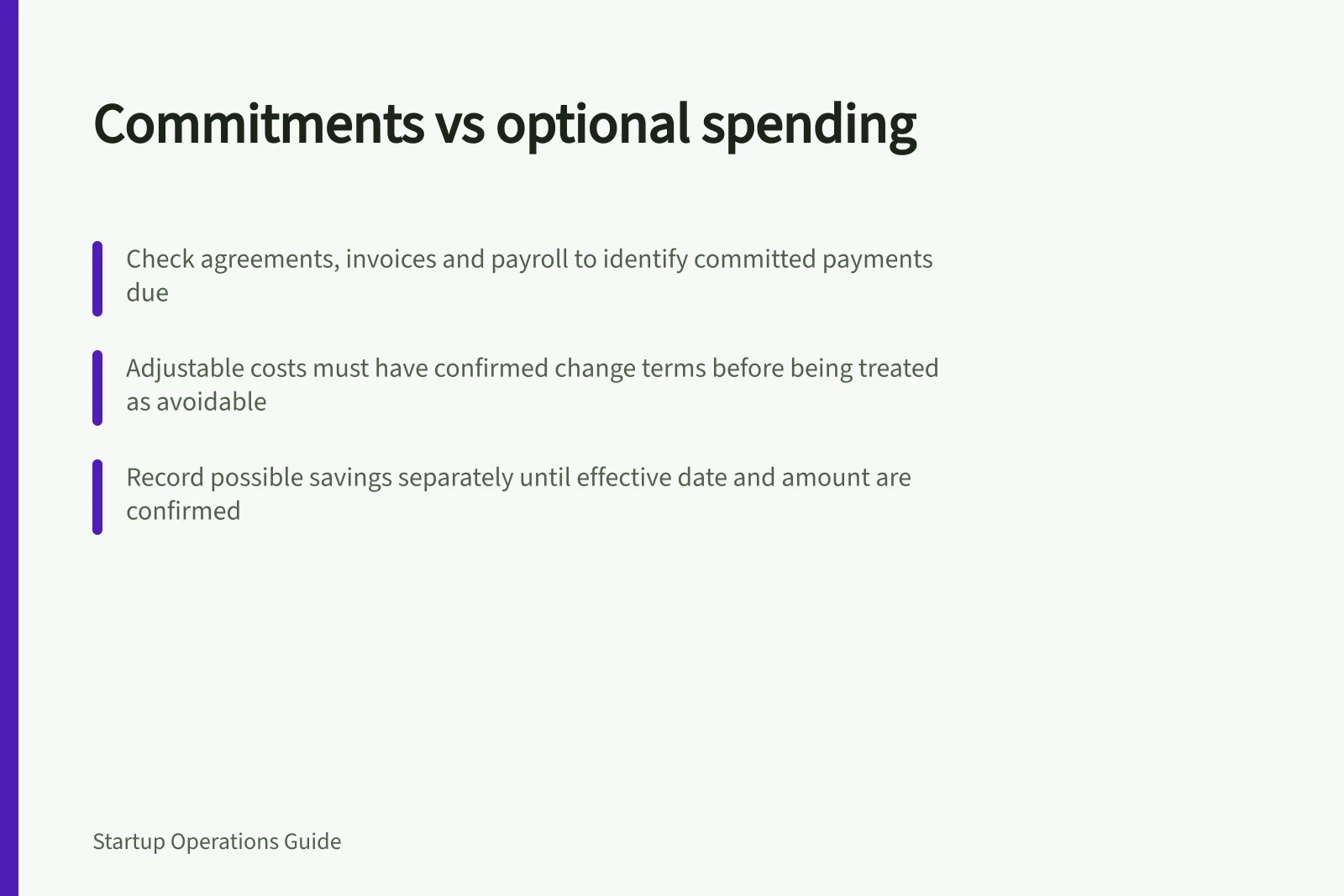
For a recurring cost, record the next payment and the earliest date a change could affect it. A seat reduction or cancellation may take effect later than the request. Until the supplier confirms the new amount and date, keep the existing payment in the working forecast and show the possible saving separately.
For a proposed hire, distinguish a decision still under consideration from obligations arising under an existing employment arrangement or an accepted offer. Do not label current employee pay or entitlements optional. Check the applicable terms before considering any change.
For a one-off purchase, establish whether an internal request can be stopped, an order can be amended or the supplier must agree. Record any cost of changing course. Do not assume cancellation is free.
Compare actions against the cash gap
For each possible change, record the amount, first affected payment, decision owner and operational consequence. Delaying a campaign might preserve cash but delay a planned test; reducing an order might protect cash but affect customer delivery. A change helps a particular shortfall only if it takes effect in time and the business can accept its consequence.
Suppose an annual tool renewal and an optional event are planned for the same month. The event may still be reassessed. Whether the renewal can change depends on its actual terms and notice date. The classification identifies the available decisions; it does not establish that either cost should be cut.
Once a change is agreed, update the commitment record and cash forecast together. Keep proposed savings out of the working forecast until their amount and effective date are supported. For a new proposed commitment, give the authorised approver its payment schedule and cash effect; the vendor approval process handles the wider purchasing decision.