Scaling Routines
Part of Scaling startup operations
Reviewing whether new management layers solve a real problem
Diagnose authority, supervision and skill gaps before adding a manager, then review whether the new reporting line improves decisions.
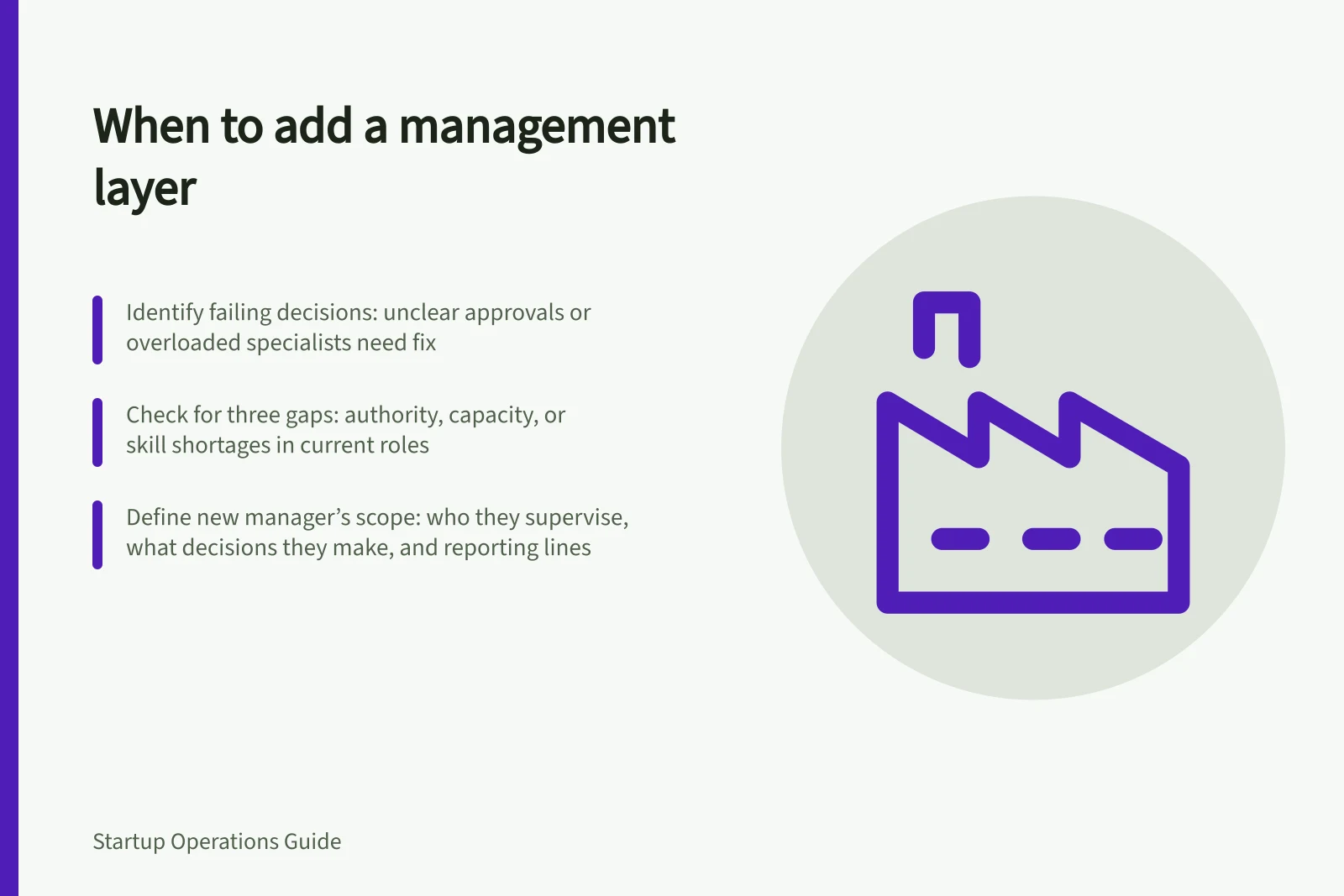
Add a management layer when continuing supervision, priority and coordination decisions need an accountable owner the current structure cannot support. First identify the decisions that fail today. An unclear approval or an overloaded specialist may need a different change.
Describe the problem in recent work
Examine cases where staff received conflicting instructions, a decision waited for a founder or an existing manager could not provide timely direction. Record the task, decision needed, who could have made it and the consequence of waiting. Ask staff what they understood their priorities and reporting lines to be.
Distinguish three patterns. An authority gap leaves people unsure who may decide. A management capacity gap leaves insufficient time for direction, feedback or support. A skill or delivery gap needs expertise or operating capacity. Several patterns may coexist.
Check whether it is clear who is responsible for each step. An organisation chart alone does not show that people know where to take a decision.
Compare changes before creating a role
| Possible change | Useful when | Question to check |
|---|---|---|
| Clarify an existing lead’s mandate | The lead handles the work but lacks an agreed decision boundary | Can they decide routine cases with the information and authority available? |
| Change the handoff or approval route | Work waits at a recurring step | Does the revised route retain the necessary check? |
| Add management capacity | Coaching, prioritisation and cross-team decisions form continuing work | Who will the manager support, and which decisions move to them? |
There is no universal headcount at which another layer becomes necessary.
Define the manager’s work
If a dedicated manager is justified, state whom they will supervise, who sets team priorities, which customer, spending or staffing decisions they may make, and what returns to a founder or another authorised person. Give them time and information to support staff, plus any reporting duty.
Check the boundaries with existing leads. An extra approval for work already owned elsewhere can add a wait. Competing instructions from two managers can create confusion. Tell affected staff which reporting line applies, where to raise a concern and how work already under way will be handled.
Plan the change with affected workers. Safe Work Australia has a page on poor organisational change management under psychosocial hazards. Check the workplace’s applicable arrangements.
Review the layer in use
Examine comparable cases after the change. Are priority conflicts settled closer to the work? Do staff receive useful feedback and know whom to ask? Has the approval route become clearer or longer? Include manager workload and staff concerns alongside delivery effects.
If the layer helps some work but slows routine cases, review its authority. If the original bottleneck remains, revisit the underlying decision, skill or capacity gap. The layer earns its place when necessary management work happens reliably and people have clear direction.