Operating Cadence
Part of Founder decision-making
Reviewing an assumption after new evidence appears
Compare new observations with the assumption behind a decision, assess uncertainty and decide whether to keep, change or replace the choice.
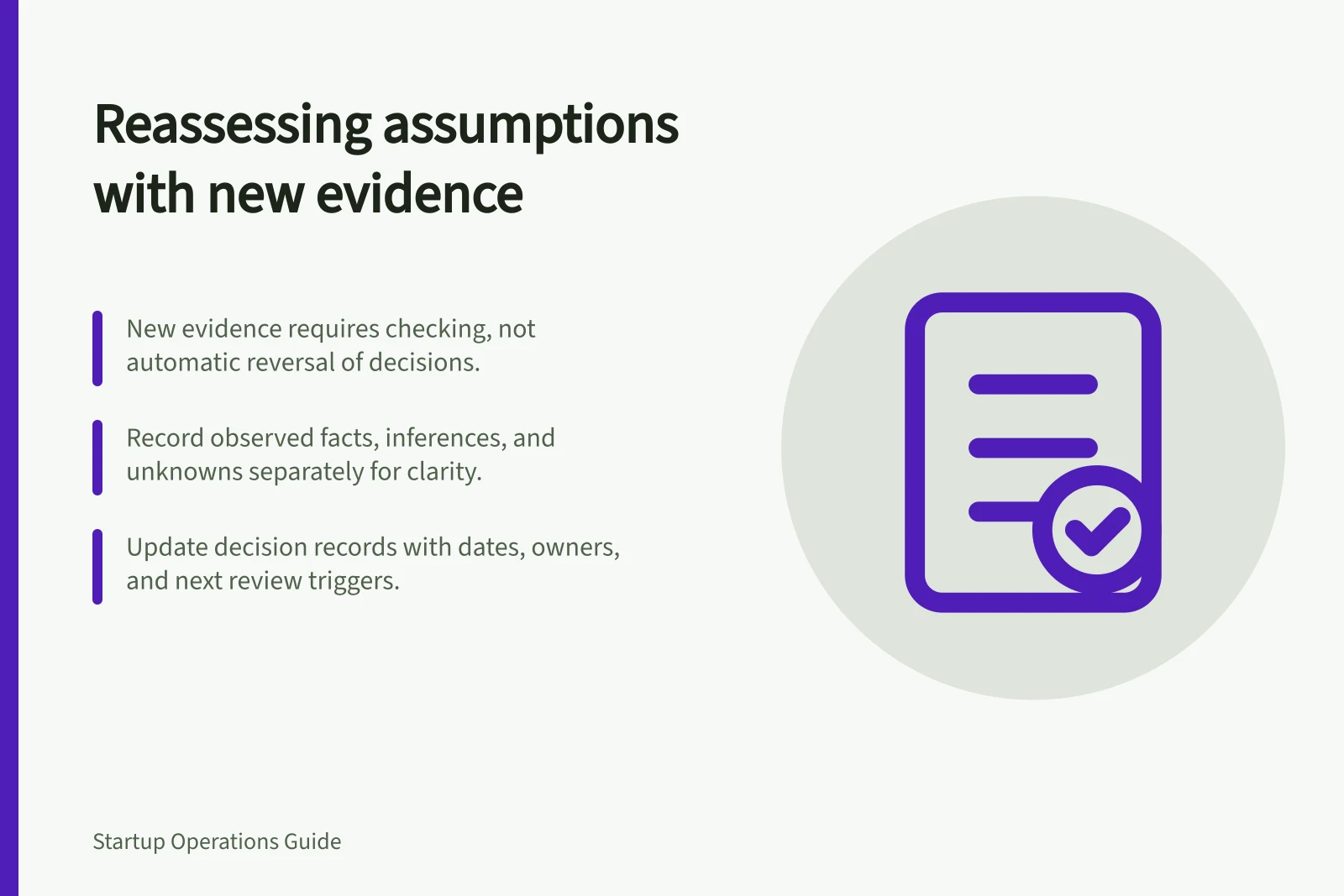
When new evidence bears on an assumption behind a decision, compare it with what the founders believed at the time. Decide whether the observation changes the available options, then record the current choice. New information warrants a check; it does not automatically require reversal.
Identify the assumption
Return to the decision's reason and write the premise as a statement that could be wrong. “Customers will provide setup information before work starts” can be checked. “The launch is sensible” combines too many judgements to test as one assumption.
Identify why the premise mattered to the chosen date, cost or ability to deliver. If the original decision did not record it, reconstruct it from information available then and label any uncertainty. Do not present a later interpretation as the founders' original reasoning.
Assess the new observation
Record what happened, when and where the information came from. Ask whether it measures the premise directly, whether the cases are comparable and what else could explain the result. One complaint or delayed case may reveal a question without showing how common the issue is.
Keep three statements separate:
- Observed:What happened or was measured?
- Inferred:What might it imply about the premise?
- Unknown:Which alternative explanation or missing information matters?
Suppose a hypothetical service startup assumed customers would supply a required setup detail within its planned intake period. Several recent handoffs lacked it. Those cases challenge the premise for those customers. The team should check whether the request was clear and timely before concluding that all customers need longer.
Observed vs. Inferred vs. Unknown
- ObservedWhat actually happened or was measured (e.g., several handoffs lacked required setup details)
- InferredWhat the observation might imply about the assumption (e.g., customers may not be providing setup data in time)
- UnknownAlternative explanations or missing information (e.g., request clarity, timing, or customer communication issues)
Decide what changes now
Consider the consequence of waiting alongside the strength of the evidence. If a current commitment is at risk, assign someone to contain the problem and communicate with affected people while the broader premise is checked. If the evidence is inconclusive and waiting has limited consequences, specify the next observation, owner and date.
The team may keep the decision and watch the premise, change one part of the plan, run a bounded check, pause a future commitment or replace the decision. State why the evidence supports that response and what remains uncertain. A premise that fails need not invalidate every part of the original choice.
If the finding affects a cash forecast, customer promise or another specialised record, ask its owner to update that record too.
Preserve the reasoning trail
Add a dated review to the decision record with the evidence, conclusion about the premise, current choice, owner and next trigger. If the choice changes materially, make the replacement clear and tell people working from the earlier position. Keep the original reason visible so readers can distinguish what was known then from what was learned later.