Delivery Ops
Part of Startup customer delivery operations
Mapping the work from signed customer to delivery
Map the route from an accepted customer order to delivery by identifying stages, handoffs, required inputs, decision points and completion.
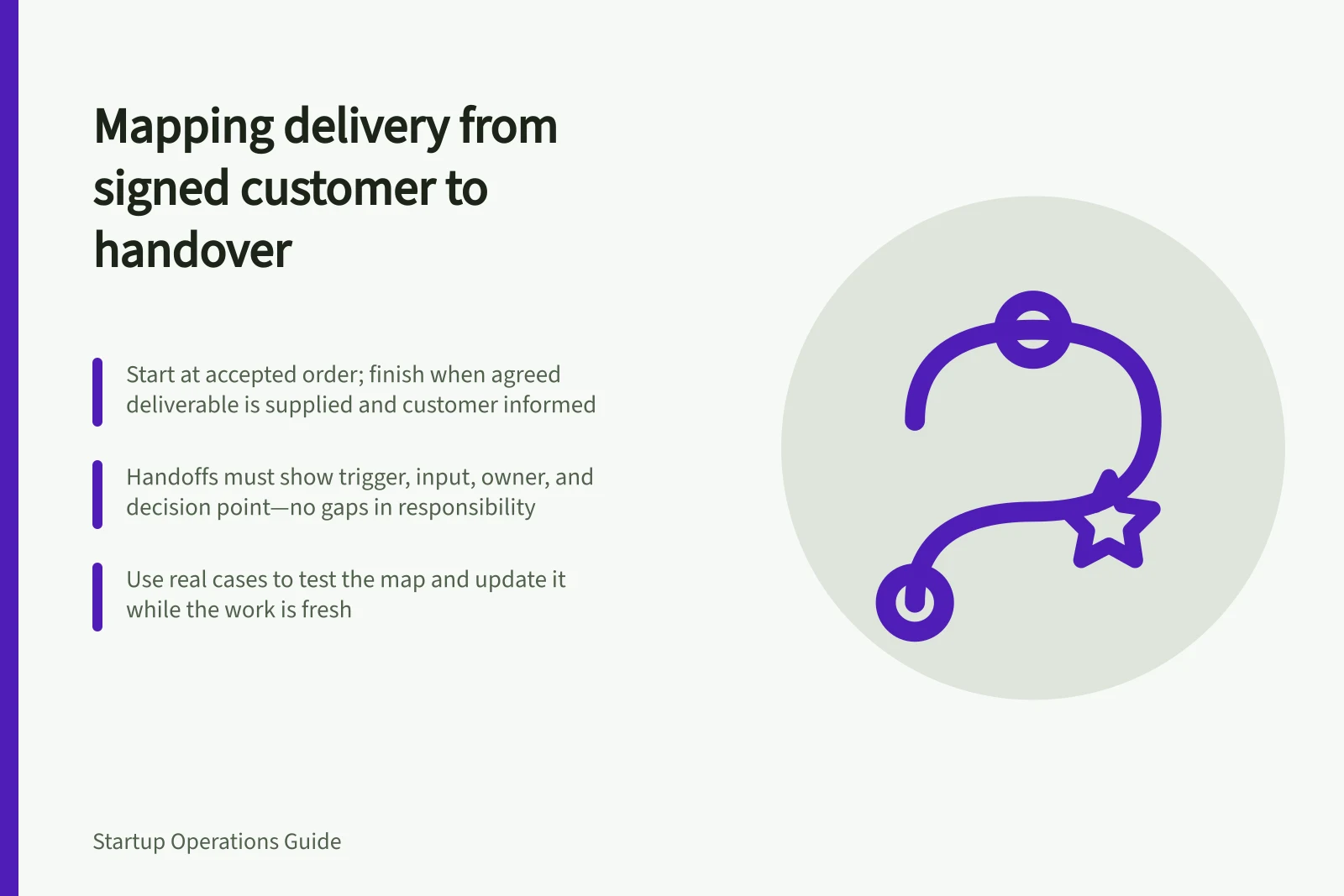
Map one accepted customer request from the point it becomes the delivery team's responsibility to the point the agreed result is supplied. At each handoff, record what starts the next step, who receives it and what they need before acting. The map should reveal waiting and unclear decisions.
Choose one actual route
Begin with a recently signed customer or accepted order for a common offer. Put the agreement and relevant work record beside the people who handled the case, then ask what happened. Mark where the customer supplied information, where the team made a decision and where work waited. Map materially different offers separately.
Set a clear start and finish. For a service startup, the start might be acceptance of the signed order; the finish might be the agreed deliverable supplied and the customer told what happens next. Show ongoing support as a handoff out of the map if it continues after that point.
Record handoffs that can stop the work
A small table is enough for the first version:
| Stage | Trigger and required input | Receiving owner | Output or stop point |
|---|---|---|---|
| Accept | Customer acceptance and agreed scope are available | Delivery owner | Confirm what can be scheduled; raise missing terms |
| Prepare | Required customer inputs and internal resources are identified | Person doing the work | Start the plan or request missing input |
| Deliver | Work is ready for its promised result | Delivery owner | Supply the result and record any open item |
| Close | Agreed completion condition has been checked | Customer contact owner | Confirm the outcome and next contact |
Adapt the stages to the offer. At each boundary, specify what the receiver must have, how they know it is ready and who resolves a missing item. One person may cover several stages in a small team; the map can still show the move from making a sales promise to planning its fulfilment.
Mark decision points as well as tasks: who approves work outside the agreed scope, who may change a delivery date, and who contacts the customer if their input is late? Where the answer is unclear, mark an unresolved decision instead of drawing an arrow through the gap.
Compare the map with a real case
Walk a suitable completed case through the draft map. Note where work entered, which detail had to be requested twice, and whether a stage was skipped because one person knew the answer from memory. Compare the drawn route with what happened; one case cannot show how often a problem occurs.
Use the map on the next suitable accepted customer. At each handoff, ask whether the required input is present and the named owner can make the next decision. Amend a missing step while the case is fresh.
Keep the map connected to live work
Place the current route where the team starts a delivery. Point from each stage to the work record it uses instead of copying customer details into a general procedure. Review the route when the offer, approval boundary or supplier dependency changes.
The map is usable when a colleague can identify a customer's present stage, next required input, responsible person and condition for completion.