Early Hiring
Part of Hiring operations for early teams
Planning an interview process with clear responsibilities
Assign interview stages, evidence and decision rights in a small Australian hiring team, with fair questions and a clear candidate handoff.
Begin with the agreed role criteria. For each interview stage, decide what evidence it collects, who collects it and who makes the final decision.
Tell candidates what to expect, ask comparable core questions and record observations before the group discusses preferences. An extra interviewer needs a defined purpose.
Give every stage a question to answer
An application may show relevant experience. An interview can explore how a candidate handled similar work or would approach a role-specific decision.
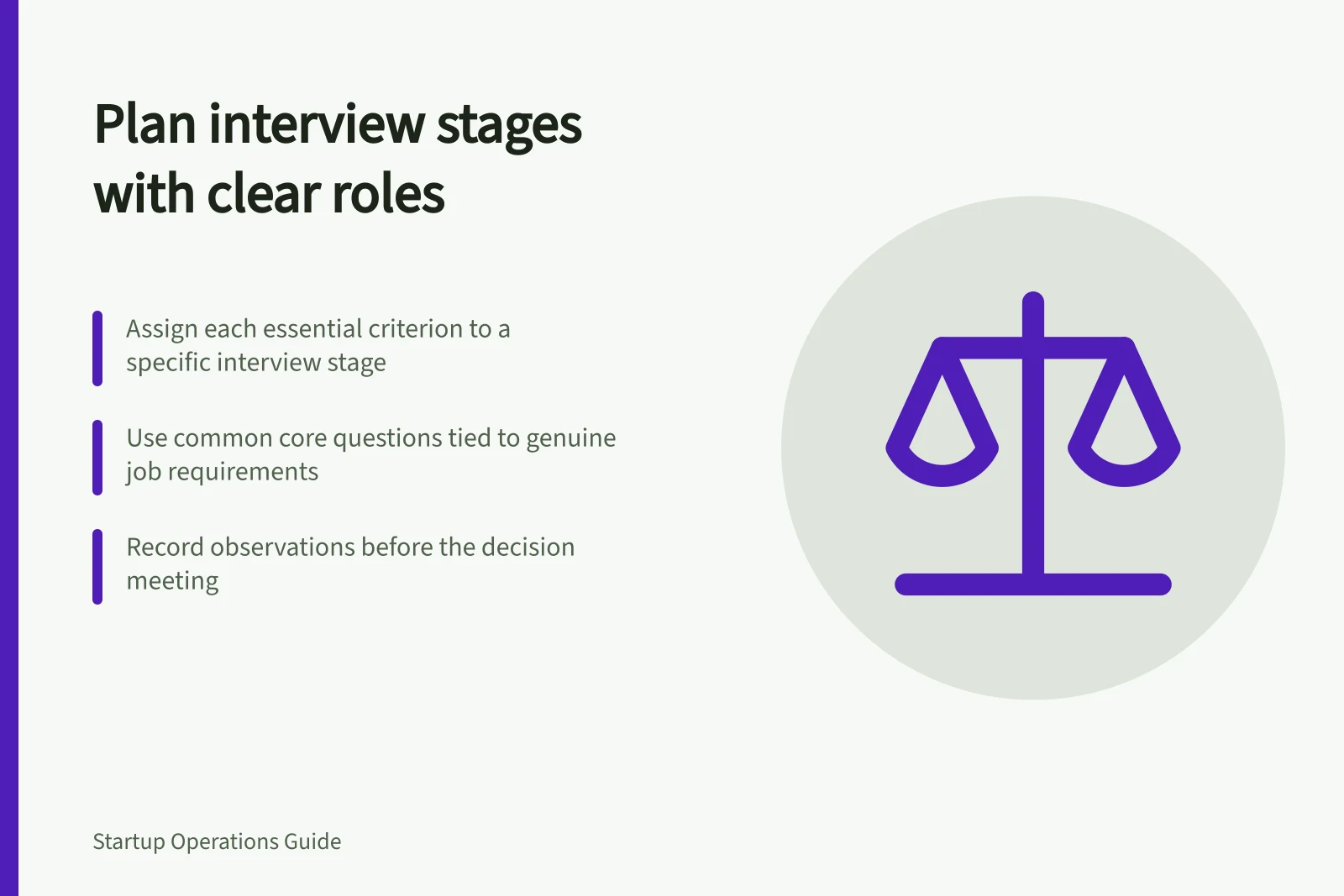
A practical exercise may demonstrate a skill if it is relevant and proportionate. Assign each essential criterion to a stage, and avoid asking candidates to prove the same point repeatedly.
| Stage | Evidence sought | Owner | Output |
|---|---|---|---|
| Application review | Evidence against essential criteria | Hiring lead | Shortlist with reasons |
| Interview | Examples and reasoning tied to the work | Assigned interviewers | Notes against their criteria |
| Further check, if needed | A specific unresolved question | Named reviewer | Finding or remaining uncertainty |
| Decision | Evidence across stages and any conditions | Authorised decision maker | Offer, further check or decline |
Remove a stage that adds no useful evidence. Before inviting candidates, agree the likely sequence and tell them the format, expected duration, attendees and any assessment.
Assign interviewers distinct work
The hiring lead schedules stages, gives candidates consistent information and follows up on delays. Assign each interviewer a small set of criteria.
A manager might assess the core duties; a colleague who would share a handoff might ask how the candidate would deal with missing information. Agree in advance which interviewer records each observation and who makes the final call.
Prepare common core questions tied to genuine job requirements. Follow-up questions can clarify an answer, but they should not turn an unrelated personal circumstance into a selection criterion.
Ask candidates whether they need an adjustment to participate in the process. For a duty involving travel or set hours, ask whether the candidate can meet that genuine requirement rather than making assumptions about family or health.
Key Compliance and Best Practice Metrics
- Privacy compliance
- Follows OAIC guidelines (https://www.oaic.gov.au/privacy/privacy-guidance-for-organisations-and-government-agencies/organisations/employee-records-exemption)
- Fair recruitment
- Guided by Human Rights Commission (https://humanrights.gov.au/sites/default/files/GPGB\_recruitment\_guide.pdf)
- Employment law
- Aligns with Fair Work Ombudsman standards (https://www.fairwork.gov.au/starting-employment/unpaid-work/unpaid-trials)
- Business support
- Supported by Business.gov.au (https://business.gov.au/people/employees/interview-and-recruit-employees)
Record evidence before the decision meeting
Use a short note form: criterion, relevant example or observation, uncertainty and any follow-up needed. Ask interviewers to complete their own notes promptly.
"Good fit" gives the decision maker little to assess; a description of how the candidate handled a relevant scenario is more useful.
In the decision discussion, compare candidates with the same essential criteria and distinguish a genuine gap from a question that remains unanswered. The authorised decision maker records the choice and any outstanding condition before an offer is issued.
Keep candidate information available only to people who need it, and check the organisation’s applicable privacy and retention requirements.
Handle exercises and the final handoff
For a skills demonstration, state the skill, expected time, supervision and evaluation method. Check current Fair Work Ombudsman guidance before asking a candidate to complete an unpaid trial.
Name the person who will tell candidates the outcome. Tell the preferred candidate which checks or approvals remain open.
Once the decision is final, pass the accepted role details to the manager preparing the start. Send the decision record and any outstanding checks to that manager, and confirm who will update each candidate.