Early Hiring
Part of Hiring operations for early teams
Defining the work before opening a role
Define an Australian startup role from real work, essential criteria, proposed hours, manager capacity and employment costs before advertising.
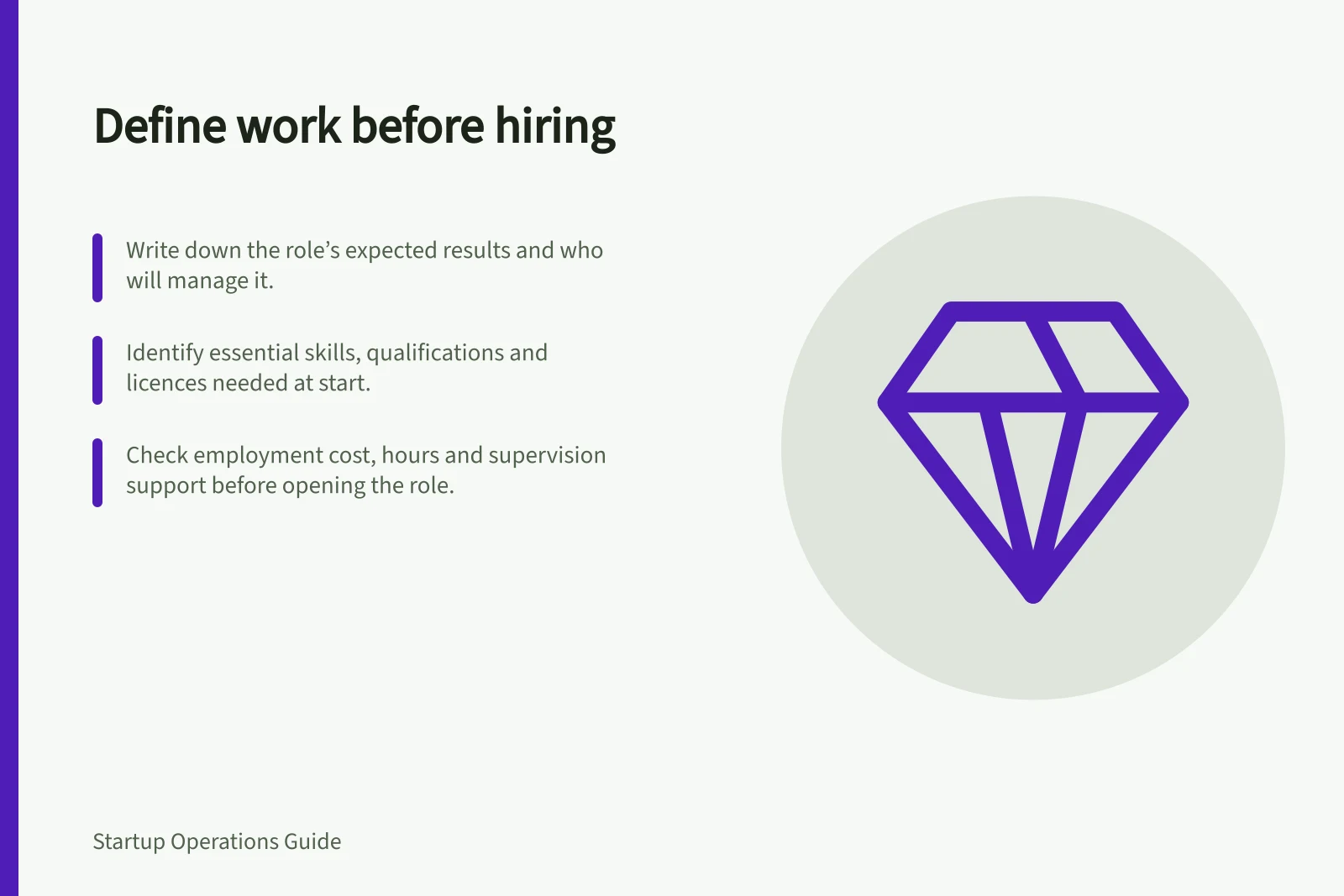
Before advertising an employee role, write down the work the person would take on, the result expected and who would manage it.
Separate duties needed from the start from work that might be added later. Then check whether the likely hours, employment cost and available supervision support the proposed role.
Defining the Work Before Opening a Role
- Identify recurring work and responsibilitiesReview founder-held tasks, delayed handovers and current workload patterns
- Separate essential from add-on dutiesDistinguish what must be done at start from what can be learned later
- Confirm management capacity and supervision supportEnsure someone is available to train, supervise and review work
- Verify legal and cost factorsCheck applicable award, classification, minimum conditions and total employment cost
- Finalise role brief and advertisementAlign ad with job brief; confirm pay meets minimums before posting
Describe the work behind the title
Review recent tasks, delayed handovers and work still held by a founder. Identify which activities recur and which require a licence or particular skill.
Set out what the employee may decide and what needs a manager’s approval. Describe one typical task from request to finished result, so colleagues can see what the role would actually do.
If the hire replaces someone, review the old description against current work. List duties that remain, duties that have changed and duties that belong elsewhere. Keep the brief about the prospective employee’s work; a wider map of founding-team responsibilities is a separate decision.
For example, “customer operations manager” might conceal a narrower need to coordinate incoming requests and pass approved commitments to delivery. The title alone does not establish the role’s scope or seniority.
Separate essentials from additions
For each main duty, record the expected output, how often the work occurs, the people involved and the point at which approval is needed. Identify skills, qualifications or licences genuinely needed to perform those duties at the start.
Put trainable tasks and preferred experience in a separate list.
Question / What the brief should answer
- What result is missing?
- The work or service the employee would own.
- What produces it?
- Main recurring tasks and important exceptions.
- What is essential at the start?
- Required skills, qualifications or licences.
- What can be learned?
- Trainable duties and desirable experience.
- Who will manage it?
- The person setting priorities and reviewing work.
Use the answers to write selection criteria based on genuine job requirements. Avoid unrelated personal characteristics or an undefined “culture fit” test that interviewers cannot assess against the duties.
Essential vs. Trainable Requirements
- Essential (must have at start)Licences, formal qualifications, specific certifications (e.g., RTO trainer qualification, driver’s licence for delivery roles)
- Trainable (can learn on the job)Software tools, internal processes, customer communication style, reporting formats
Check the role’s shape and cost
Estimate when work arrives, whether coverage is needed at set times and whether the need is ongoing or bounded. Use that pattern to consider a proposed employment type.
Check the workplace relations system that applies to the employer, any relevant award or agreement and classification, minimum conditions and total employment cost.
A preferred label or contract heading does not settle a worker’s legal status.
The manager also needs time to train, supervise and give feedback. If nobody can explain or review the work, narrow the role or assign that management responsibility before opening it.
Approve a brief candidates can rely on
Finish with the role’s purpose, main duties, essential and desirable criteria, reporting line, location, proposed hours and employment type, decision limits and offer approver.
Check that the advertisement reflects the brief. If it states a pay rate, confirm that the rate meets the applicable minimum before posting it.
The role is ready to open when the hiring lead and manager agree on the work and can identify what evidence would show a candidate can do it. Interview planning can then begin from an agreed job rather than being used to discover what the business meant to offer.