Operating Cadence
Part of Startup planning and execution
Reviewing progress without creating a reporting burden
Use brief owner updates and existing evidence to review startup initiatives, resolve exceptions and remove redundant reporting.
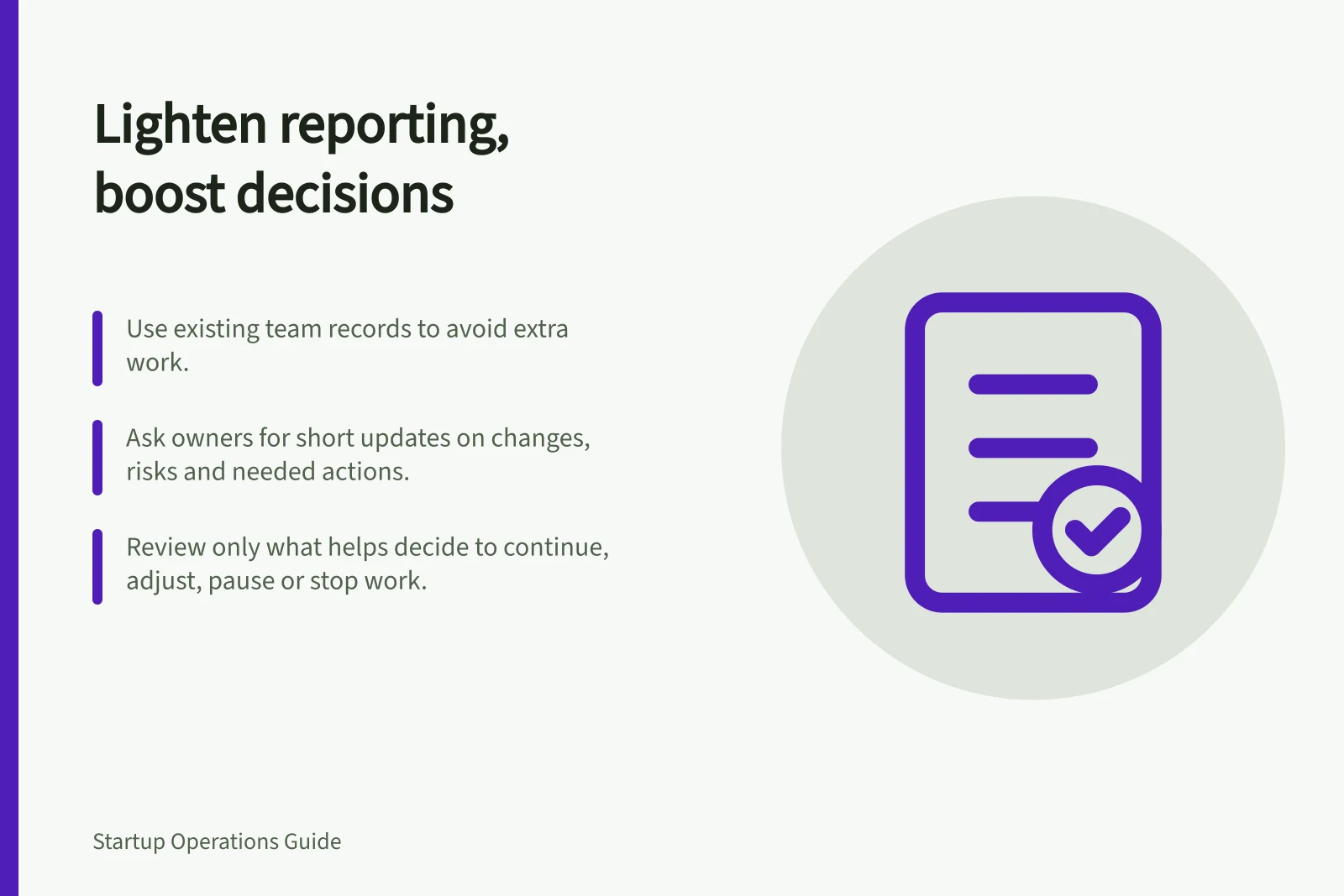
Review initiative progress using the smallest update that supports a decision. Start with information the team already records, ask owners to explain meaningful changes, and spend discussion time on exceptions.
A review should help the team continue, adjust, pause or stop work. A longer report is useful only if it improves that choice.
Decide what the review needs to answer
For each current initiative, ask whether its intended outcome remains relevant, whether the latest evidence points in the expected direction and whether a decision is needed. Choose the observation and review interval to fit the work.
A deliverable due soon may need a near-term check; an outcome that changes slowly may need a longer period. The team can still raise a blocker as soon as it appears.
Use the evidence source agreed when the initiative began. If it changes, note that so readers do not compare unlike figures as though they mean the same thing.
Where evidence is incomplete, state what is missing and what decision can be made despite the gap.
Evidence-based review indicators for startup initiatives
- Intended outcome relevance
- Check if still aligned with business goals
- Direction of latest evidence
- Assess whether data points as expected
- Decision readiness
- Confirm if a decision is required now
Review intervals based on initiative type
- Deliverable due soon
- Near-term check (e.g., weekly)
- Outcome that changes slowly
- Longer interval (e.g., monthly or quarterly)
- Blockers
- Raise immediately—no waiting for review cycle
Ask for a short owner update
An owner can prepare the review from the initiative record and the working system. A compact update answers:
- What changed since the last check?
- What evidence supports that view, and what remains uncertain?
- What is at risk or blocked?
- What decision or help is needed, from whom and by when?
Linking an internal working record is a team choice; copying every task into a second report usually adds maintenance work. The update can be a few sentences when nothing material has changed.
A status label alone is less useful than the reason for it: “At risk because the agreed customer data is unavailable; the owner needs a decision on an alternative sample.”
Discuss exceptions and record the response
Read routine updates before any live discussion. Bring together the people needed to settle a dependency, trade-off or change in direction.
The review can be written if the evidence and next action are clear. If people meet, start with the decisions requested rather than a tour of completed tasks.
For each exception, record the decision, its owner and the next check. The options may be to unblock work, narrow the initiative, seek better evidence, defer it or stop it.
Tell affected people when dates or commitments change. A missed milestone should remain visible; changing the target after the event without explanation hides information the next plan needs.
Consider a hypothetical startup testing a revised customer intake. The owner reports that the form is in use but some handovers still omit the agreed scope. The useful review question is whether the missing detail comes from the form, the sales conversation or the handover step.
A list of every form edit would not answer it. The team could inspect a suitable sample and decide which part to change next. No improvement is assumed from the example.
Remove reporting that has no reader or decision
Periodically ask which fields people used to make a decision. Retire duplicate status fields and measures that nobody can interpret.
Keep a measure only if its definition, period and source are clear enough to compare at the next check. Preserve the short history needed to see why a priority or target changed.
The method is working when an owner can prepare an accurate update from existing work, the team notices meaningful risks in time, and each review ends with a clear next decision or check. If preparation becomes substantial, reduce the requested material before adding another dashboard.